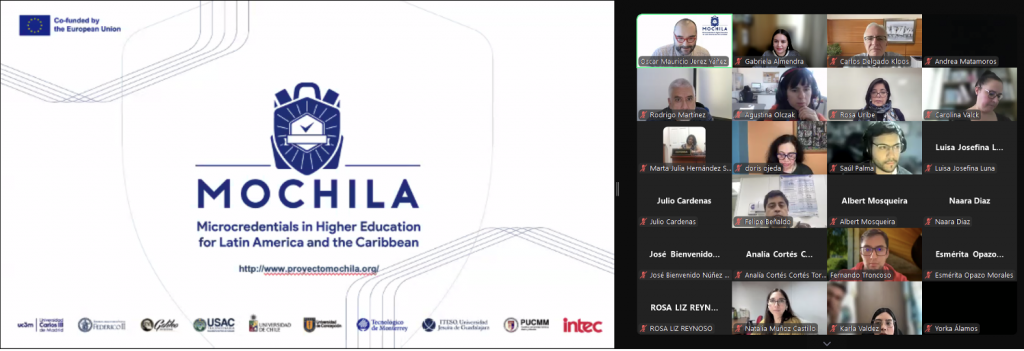

On May 29, 2025, the first regional workshop of the Erasmus+ MOCHILA Project was held virtually, organized by the University of Chile. The activity aimed to collectively reflect on the key elements needed to build a regional framework for micro-credentials in higher education institutions across Latin America and the Caribbean.
The workshop was led by Prof. Óscar Jerez Yáñez, Associate Professor in the Department of Health Sciences Education and coordinator of the MOCHILA team at the University of Chile. It also featured the distinguished participation of Prof. Carlos Delgado Kloos, Full Professor in the Department of Telematics Engineering and Director of the UNESCO Chair in Scalable Digital Education for All at Universidad Carlos III de Madrid.
The session began with Prof. Delgado Kloos’s lecture titled “Digital Micro-credentials for Recognition,” which addressed the value of these certifications in professional requalification, employability, and the recognition of specific learning achievements. The presentation also emphasized their alignment with international frameworks such as Europass and ESCO, and proposed the use of agile methods for designing educational content through principles of courseware engineering.
Following the keynote, Prof. Jerez led a participatory workshop focused on identifying commonalities, shared challenges, and critical considerations for designing regional policies on micro-credentials. The more than 190 participants—from countries spanning Mexico to Tierra del Fuego—worked collaboratively in groups using a guiding questionnaire to discuss key topics such as institutional recognition, validity periods, formality, issuance, and circulation of micro-credentials.
With more than 500 people registered, this activity marked a significant milestone for the MOCHILA Project and demonstrates the growing regional interest in advancing innovative certification systems that support flexible and lifelong learning.